By Charlotte Dubois
It is almost peculiar to think of history in the context that all of which we have discovered of human kind is rooted back to a time so long ago. On the contrary, civilization and its innovations are relatively new on a grand scale. We live in societies where evidence points to us as still being immature and that our ancestral ties can be counted on two hands by generations as we hit year 1 a.d. We are living in the past, present and future simultaneously. Through events in human history such as social movements, we can literally see the waves of behavior, innovation, religion, communication and travel as we march through time. An excellent way to paint a picture of this motion is through studying the effects of policy.
Policy isn’t necessarily what rules or laws a contemporary government enacts or the guidelines with underwriting found in corporations, rather, lets look at policy as the rules and traditional ideas of any hierarchy of order over a society or individual. We can also argue that tradition is a set of moral rules enacted by parental or authority figures. When studying the effects of policy for example, we know the governmental systems become introduced with a need for policy as social change erupts to the surface within its society. The time it takes for the under currents brewing within society to break as surface waves, to the introduction of a response policy, straight to when a policy becomes agreed upon and enacted, if at all, has been enough time for the new social norm to already be adapted within its society. While butting heads with the opposition to change, the behavior correction or acceptance, integrates into society. The time spent for the undercurrents pushing change, the change to be created, then push toward moral values and adapt into society, without counting the time it takes for the acceptance and integration of the new policy, already consists of two generations or more. The change and its opposition engulf society, creating polarized ideas that are ultimately carried through generations as traditional values; pro something or anti that something. When a rule or moral value becomes suggested to be enforced or at least adopted, there is a period of time for transition, acceptance and resistance. Marijuana legalization, abortion, women’s rights, human rights, an eight hour work day, sustainability, segregation, Christianity, urbanization, economy, the list goes on for deeper thought.
Being able to recognize some of the named movements through history proves that the issues have been inherited for reasons such as policy change or the lack thereof within the time frame that any social discourse or lack of a school of thought against social norms, forces it to the surface of society. Some of these issues are so sequential, that we can see the wave of social change pull back out to sea, but high tide is coming in and the waves never descend fully back, as the ocean of change moves deeper onto shore, leaving less space for reaction. But as we know from science, that high tide will eventually digress to low tide and back again. Some of these controversial issues have become ingrained into the psychology of societies, sometimes dependent on the size of the population that hold generational values formed from the original discourse. The question I ask is what happens to the waves as we advance to a globalized society? We are globally intertwined through communication, media influence, entertainment, commerce and economically. What can be predicted? What can be manipulated for the “better good” by the idea of a majority, whether that majority be good for all or not? How can we know if its high tide or low tide? How can we watch the obvious tide roll in and out from the surface without considering the under currents and forces unseen pushing the movement? We live in the shadow of moral tradition from our ancestors. For example, the “Enlightenment” was a period of time which can be categorized as one of those undercurrents. Without the philosophical school of thought, questioning the norm, the western worlds and their governments, education, self awareness, individual freedoms and cultures might be just a little different.
If we were to use a Venn Diagram of coding named and unnamed movements to separate primal behaviors and those related to being civilized, we might be able to prove the immaturity or progress of humans after observing the shared behaviors. Those shared behaviors can shed light on how close our current, so called, ‘evolved’ behaviors are to the beginning of it all, to find a predictable primal course which we still function.
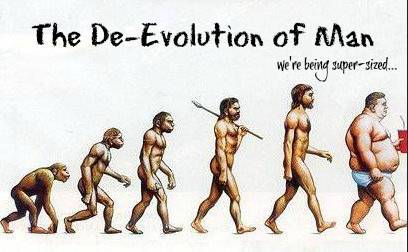
 A Journey Through Humankind